Los Angeles is blessed with one of the most beautiful main libraries in the whole country. More than a building, at times the Central Library feels like a temple to the written word, with architecture meant to inspire awe and artwork created to delight. It’s one of the architectural highlights of the city, and also one of its best cultural centers.
As with any good library, the Los Angeles Public Library (LAPL) across its main library and its many branches is not just a collection of books, but a gathering place for the community. Patrons are provided with services such as internet access, adult literacy programs, recording studios, movie rentals, citizenship classes, and perhaps just as importantly, a quiet place to relax and simply be.
We’ve skirted the Central Library in some of our previous guides. We walked past it on our Bad Art Tour and we included it as one of the locations in our City of Ghosts guide. But we’ve yet to really explore it, to take in all it has to offer.
The Central Library is located on 5th Street, between Grand Avenue and Flower Street. There are three entrances: 5th Street, across from the U.S. Bank Tower and the Bunker Hill Steps; Maguire Gardens, facing Flower Street; and on the south side of the building at the end of Hope Street, facing 6th Street. Central Library’s operating hours are Monday-Thursday 10am-8pm, Friday-Saturday 9:30am-5:30pm, and Sunday 1-5pm.
The closest Metro station is 7th St/Metro Center, just a few blocks south of the library. The most direct route is to exit the station at 7th/Hope, then walk up towards the library, which you’ll see at the end of the street (passing a convenient location of 85°C Bakery Cafe on the way). This is the Hope Street entrance, which was considered by the original architect as the most impressive entrance, with figures atop the pillars representing classic fields of human knowledge. It should be noted that this entrance does require climbing some stairs, so if that’s an issue, you can walk up Flower Street to the entrance there instead, facing the Maguire Gardens.
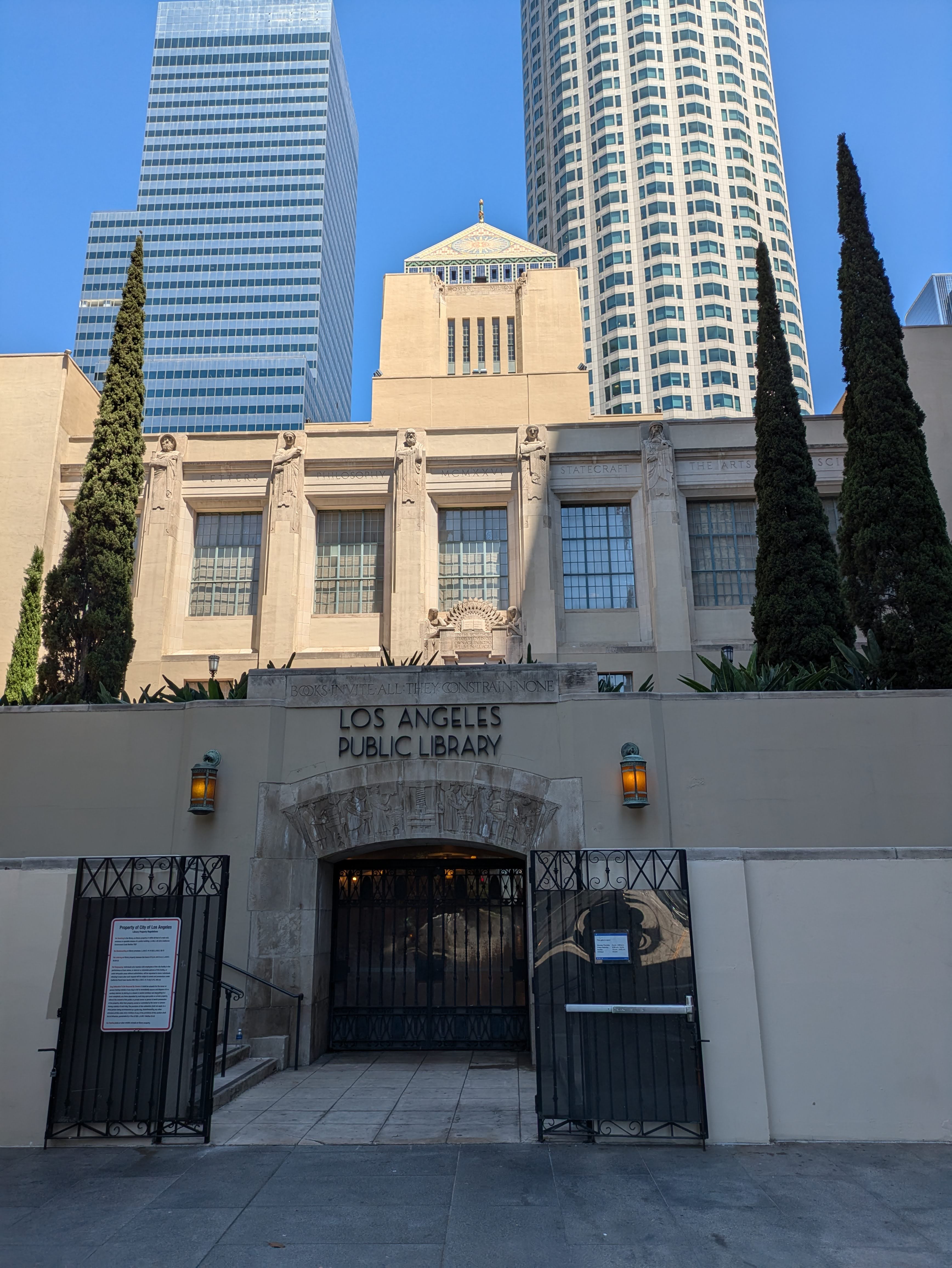
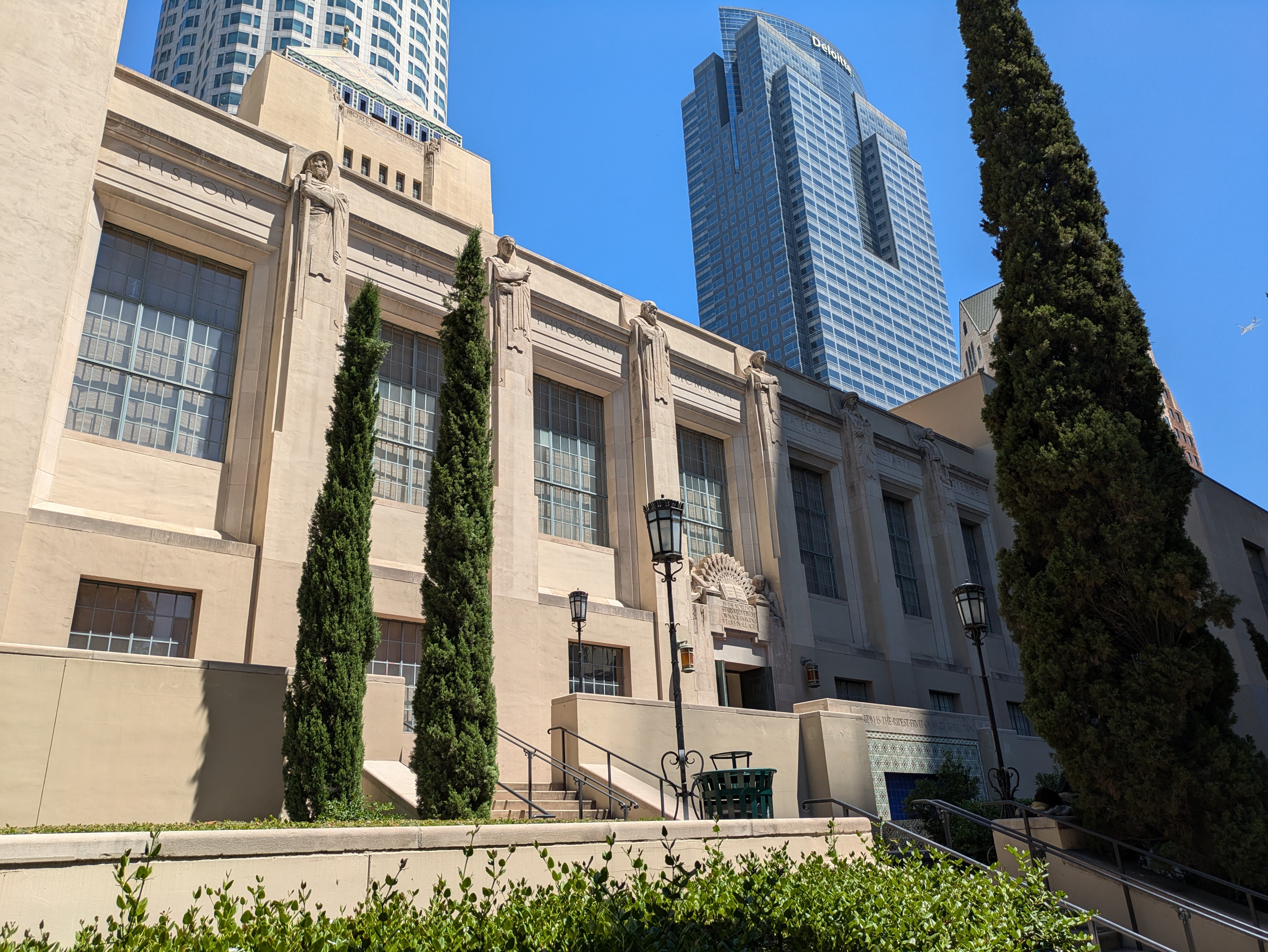
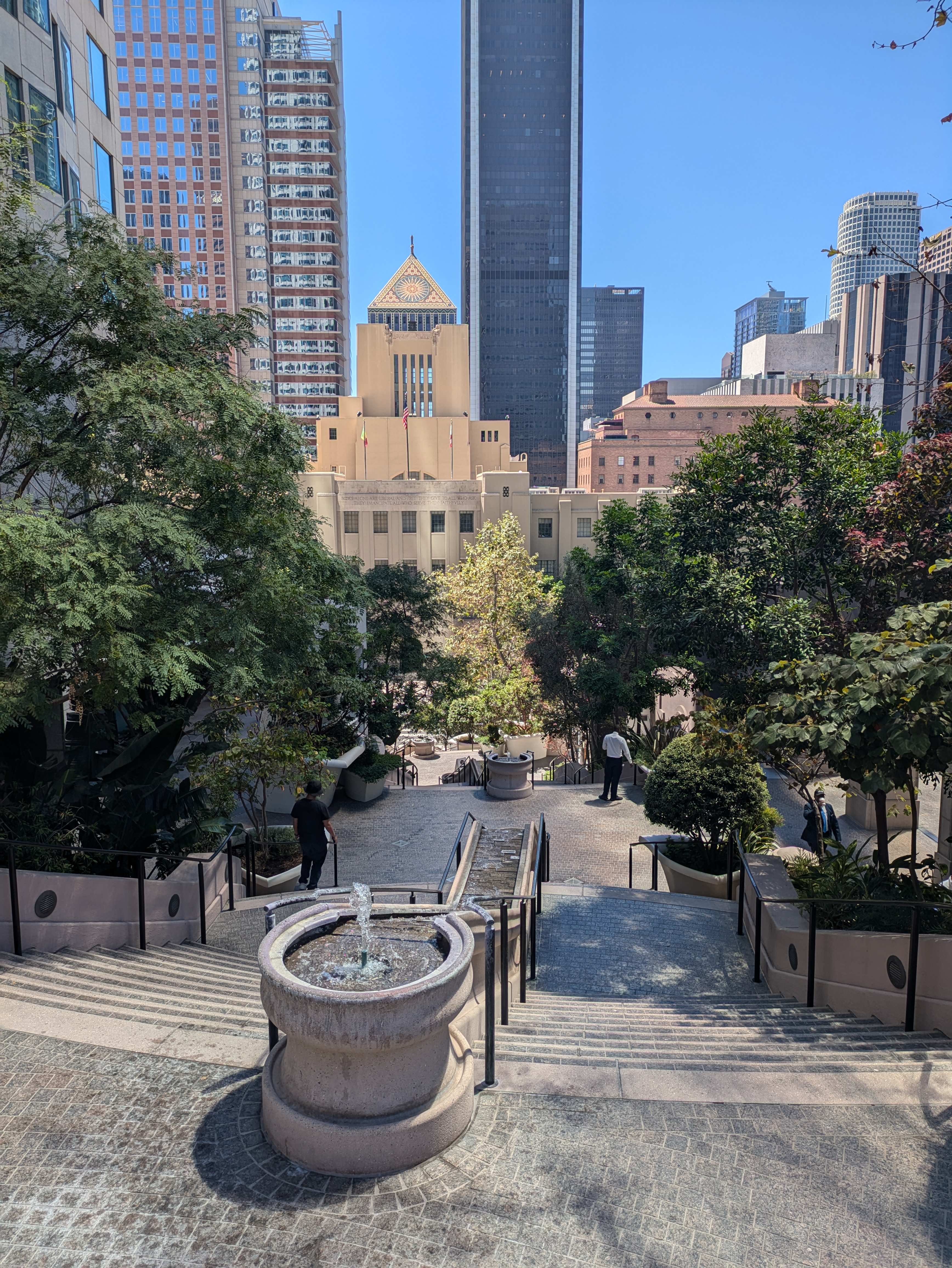
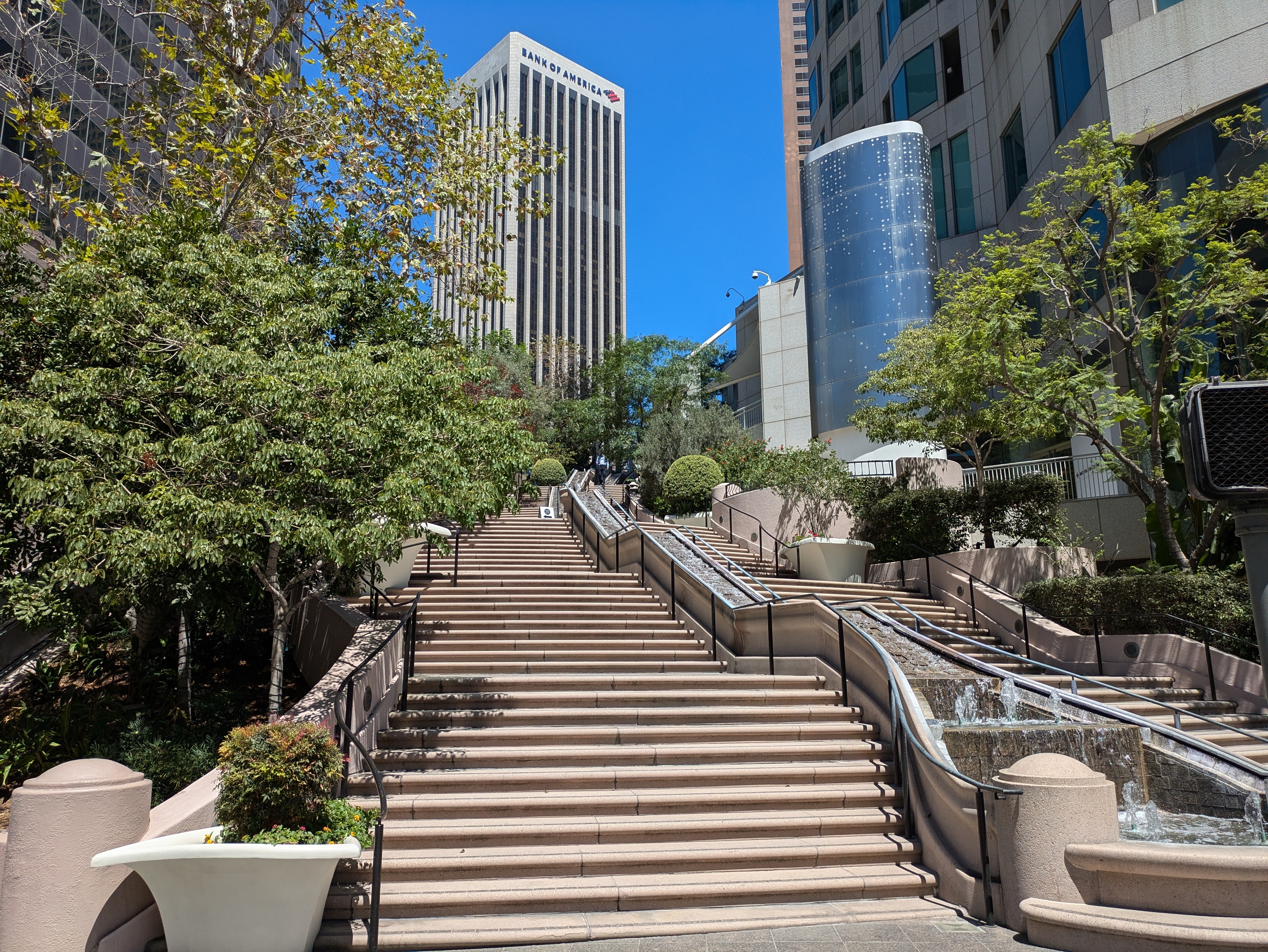
If you’re coming from the Grand Avenue/Bunker Hill district, the better option is to walk down Hope Street (one block west of Grand) towards the U.S. Bank Tower (which itself owes its existence in part to the library), then walk down the scenic Bunker Hills Steps down to the 5th Street entrance, enjoying an iconic view of the library on the way down.
The Central Library is made up of two buildings: the original structure completed in 1926 (with the pyramidal tower), and a massive 1993 addition that contains most of the actual stacks. All the entrances converge next to the circulation desk, in the middle of the first floor of the original building, where you’ll find a handy cutaway map of the building, which is so straightforward we might as well just use it here:

The original building is two floors, with the spectacular rotunda being on the second floor. The 1993 addition is eight floors, four belowground and four aboveground, surrounding a towering atrium. Both are architectural highlights of the building, and will serve as our anchor points for our tour of the building.
Maguire Gardens
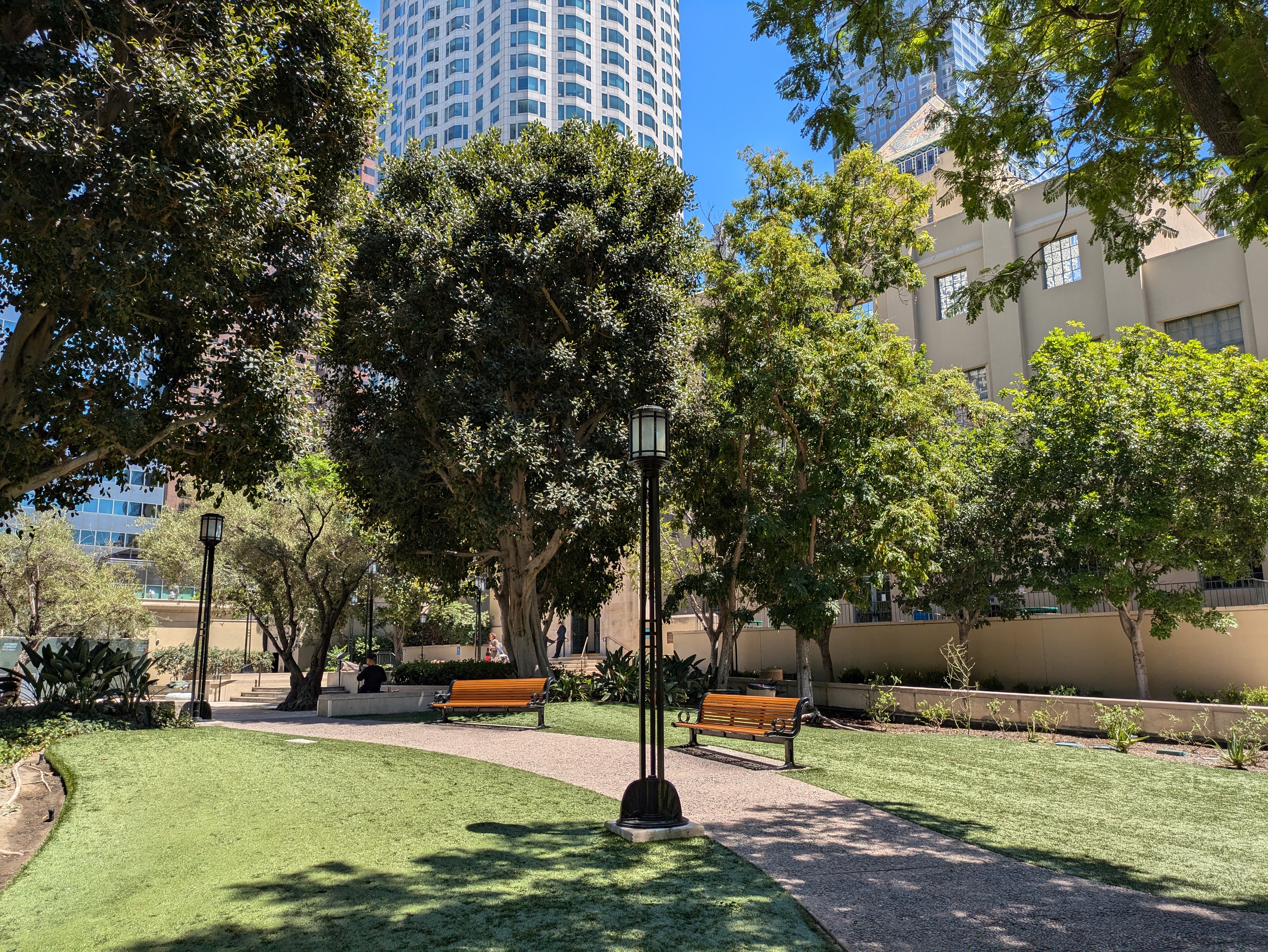
When it opened in 1926, Central Library had a lawn on its west side, facing the corner of 5th and Flower, but this was paved over in 1969 for a parking lot. When the library was renovated and expanded in the early ’90s, the parking lot was replaced with an underground garage, providing the opportunity to restore the green space that had been lost. A lush square of shady trees now sits on the space, with a curving path under the trees and an iconic tiered entryway leading up to the west entrance.
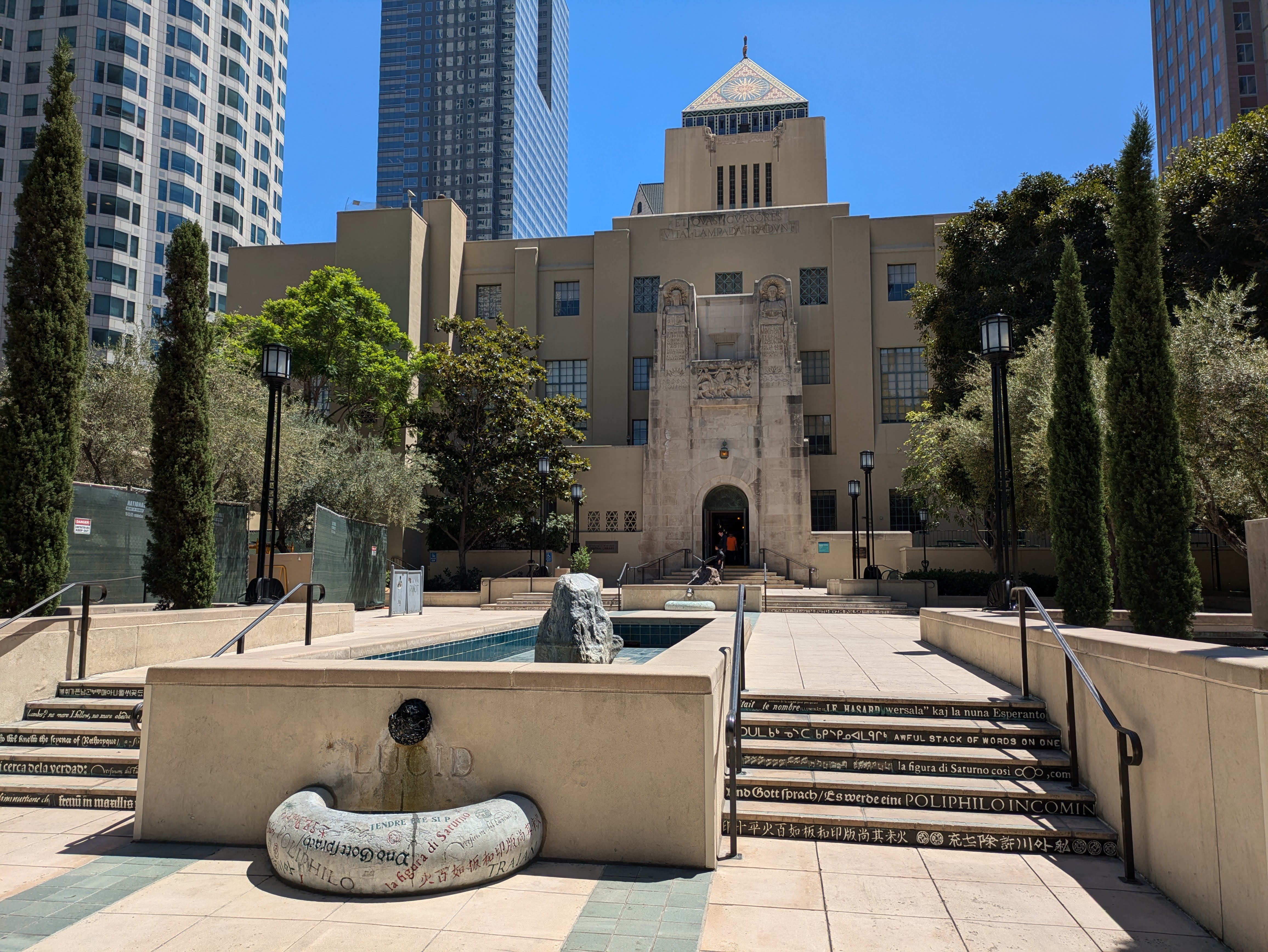
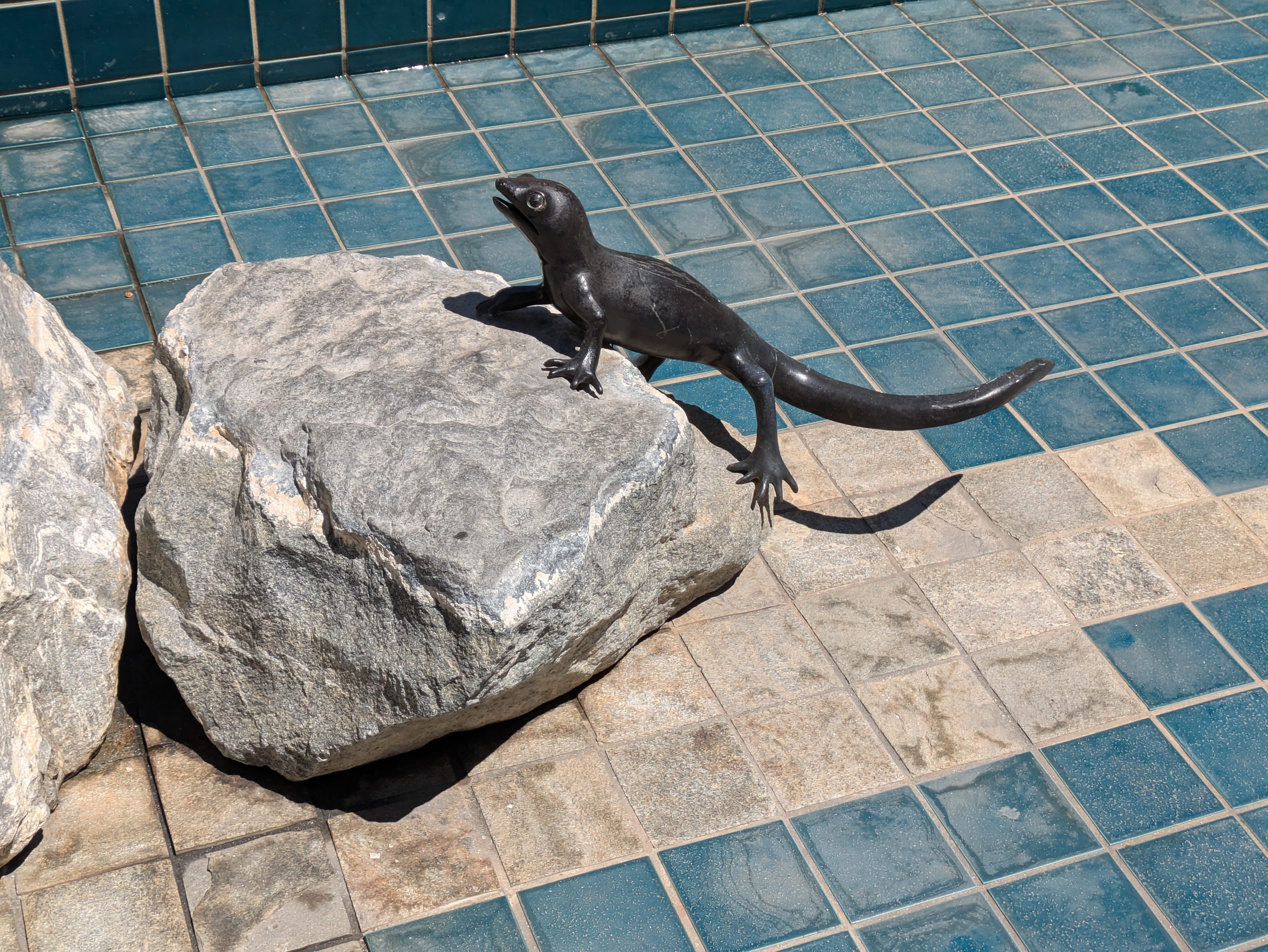
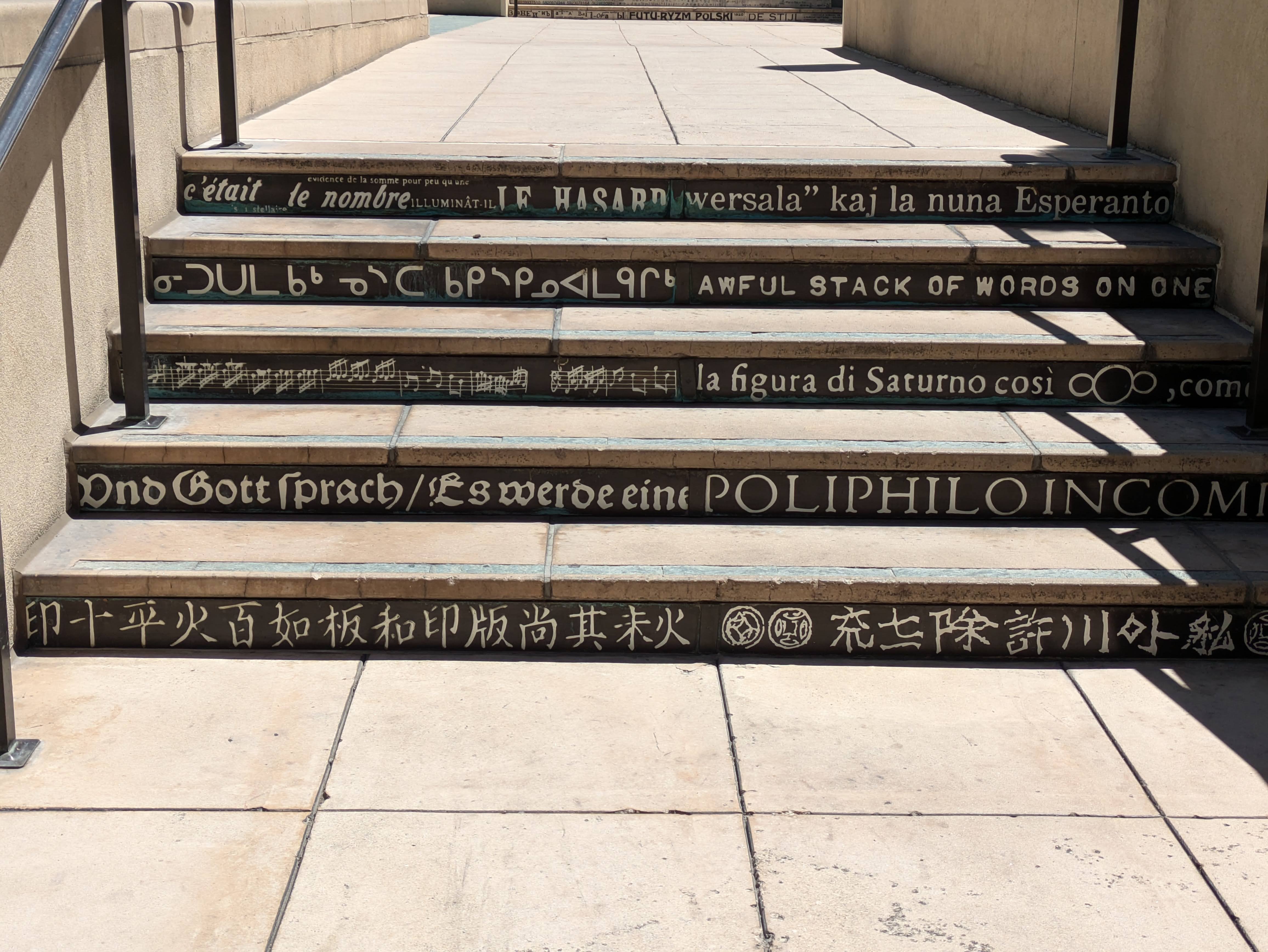
The centerpiece of the gardens is Jud Fine’s Spine, a complex artwork that lines the tiered fountain, which has lacked water for many years now as a water-saving measure. The theme of the work is evolution, tracing the development both of natural life and human knowledge. The bottom pool contains a replica of a skeleton of a labryrinthodont, an ancient amphibian, which looks like it came directly from a natural history museum. The middle pool holds a bronze sculpture of a newt, while the top pool has a sculpture of a peregrine falcon taking flight. All around the fountain and inlaid into the steps are various words and pictographs representing the development of the written word. It’s marvelous stuff, and takes some careful scrutiny to take it all in.
Main Lobby
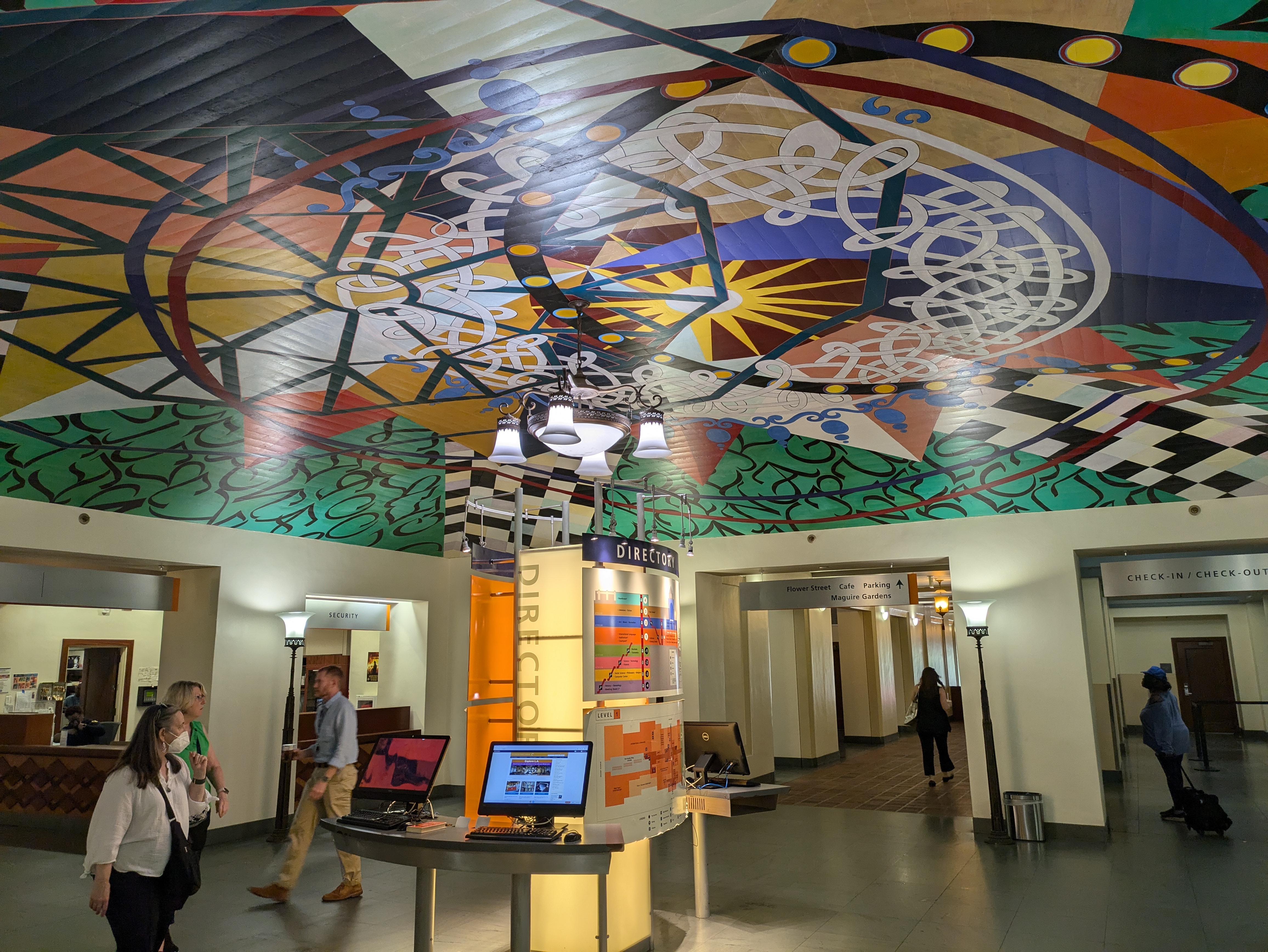
By contrast with the majestic rotunda and atrium to come, the lobby is a decidedly functional space, with low ceilings and most of the service functions clustered tightly together. A colorful mural, Renée Petropoulos’ The Seven Centers, adorns the ceiling above the center of the lobby, in part referencing the designs of the rotunda on the floor directly above.
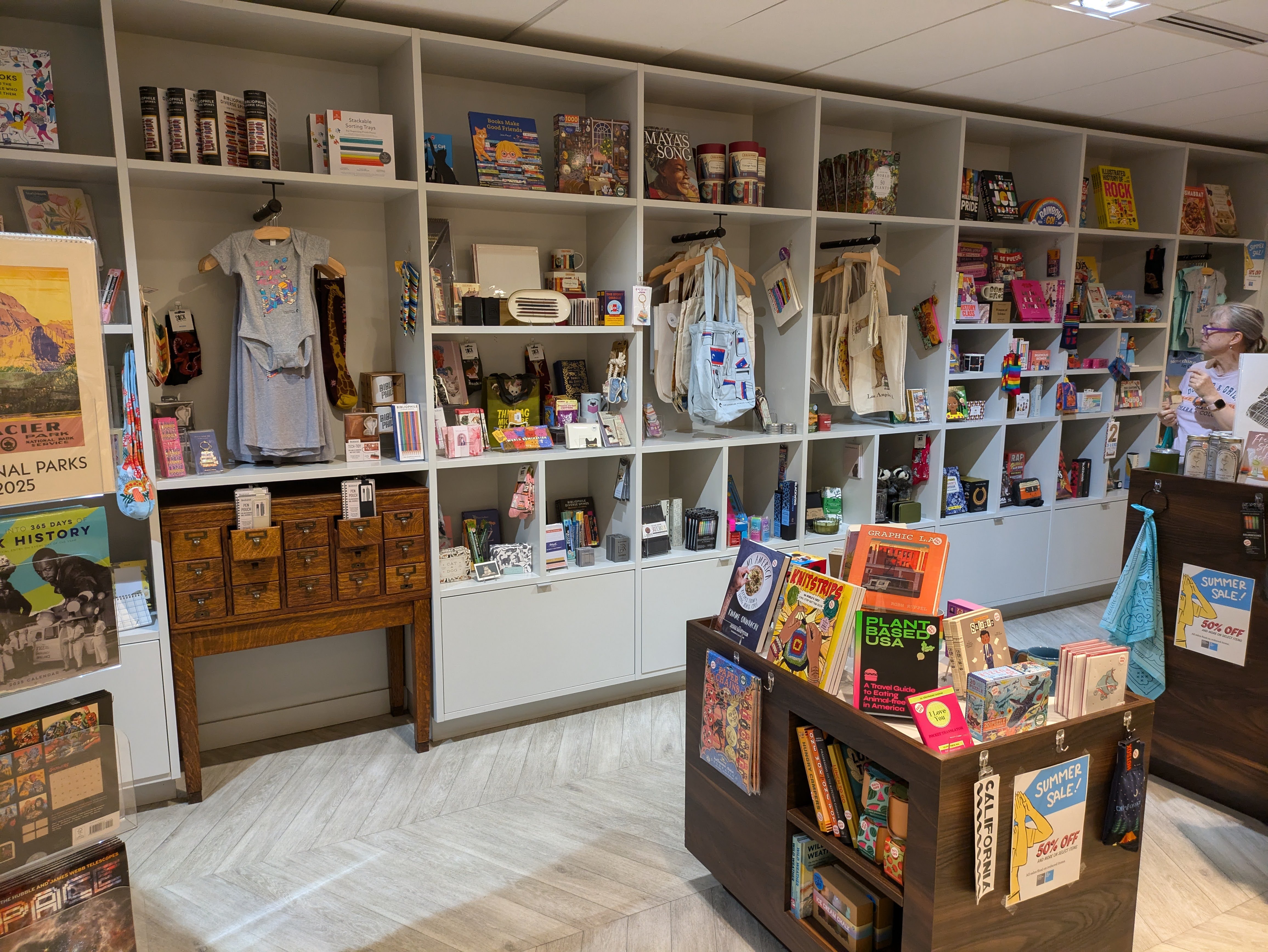
One feature worth checking out for visitors is the Library Store, which has a small but excellent selection of merchandise for sale. Most of it is books and stationery focused on L.A., but there’s also T-shirts, tote bags, and merch specific to the library and some of the exhibitions the library has hosted.
From here, you can either take the escalators up to the second floor to view the historic rotunda, or continue down the hallway towards the atrium, which will take you past the First Floor Galleries, which host changing exhibits spotlighting local artists or a subject of L.A. history or culture, oftentimes with a connection to the LAPL system.
Rotunda
The original library building was designed by Bertram Goodhue, one of the most significant architects in Californian, if not American, history. Perhaps his most famous building is the Nebraska State Capitol building, which eschewed the typical classical domes in favor of a massive 15-story Art Deco tower. In California, he is most significant for popularizing the Spanish Colonial Revival style with his design for the 1915 Panama-California Exposition (today’s Balboa Park in San Diego), which was so beloved that it was widely adopted as the signature California style.
It was off this reputation that Goodhue was commissioned to design Los Angeles’ new library. His early sketches of the library incorporated a dome and more ornamentation, based off of his Balboa Park work, but over time was refined into a more personal style inspired by a mix of influences. While designing it, he wrote to a colleague, “My Gothic is no longer anything like historically correct, and my Classic… is anything but classic… At Los Angeles, I have a Public Library in the same strange style I have been telling you about.” The ornamentation was gradually stripped away in favor of a simpler, more modernist design reflecting the Art Deco tastes of the time. The dome was replaced with a pyramidal tower, inspired by Goodhue’s interest in Egyptian history, which itself was invigorated in the popular imagination by the then-recent discovery of King Tut’s tomb. Goodhue would pass away in 1924 with the library design nearly finished, leaving it up to his local associate Carleton Winslow to see it through to completion.
Take the escalator up to the second floor and double back down the hallway and you’ll enter the spectacular rotunda, the historic heart of the library and arguably the architectural highlight of the building, as well as the key to Goodhue’s original design.
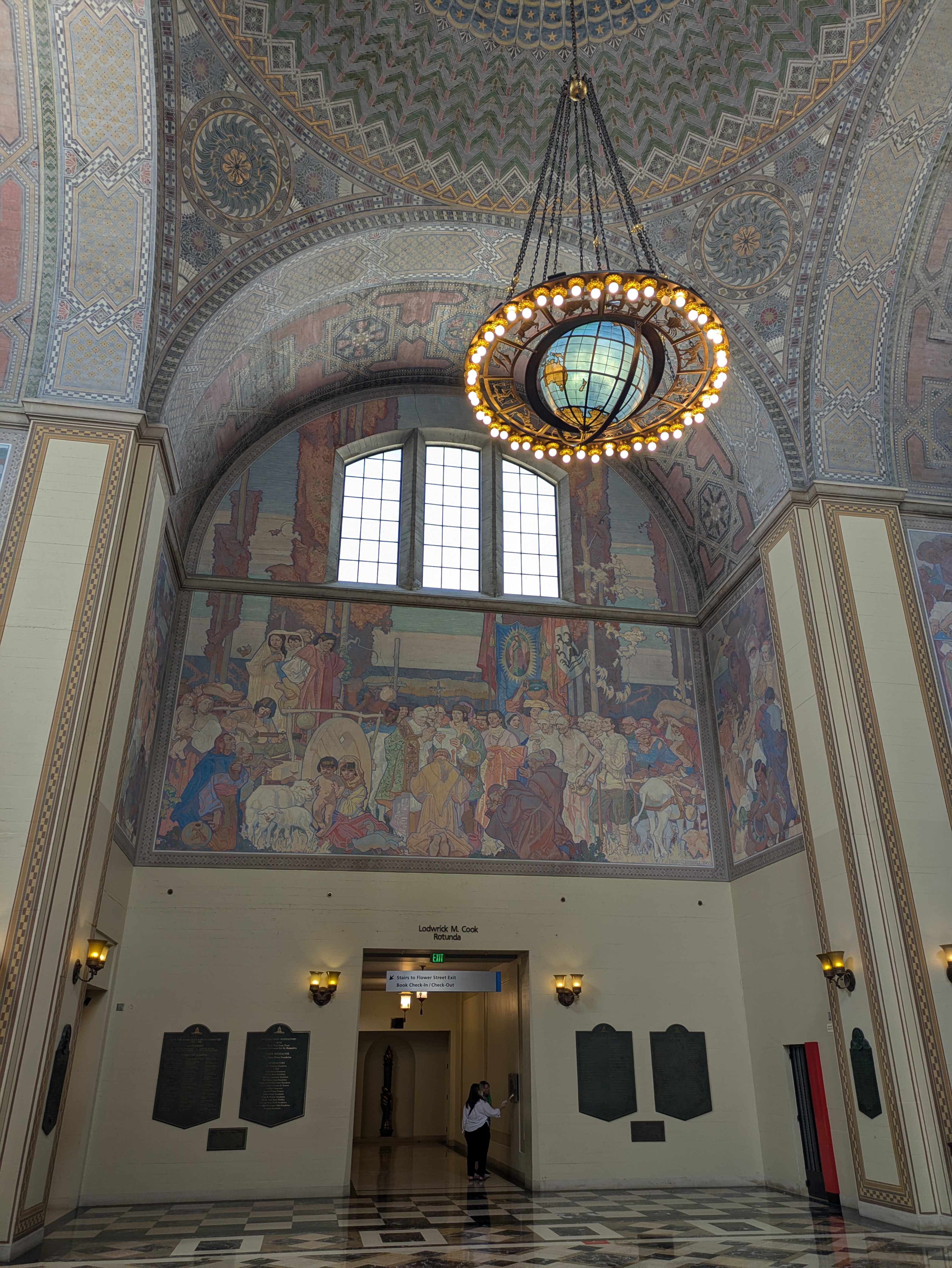
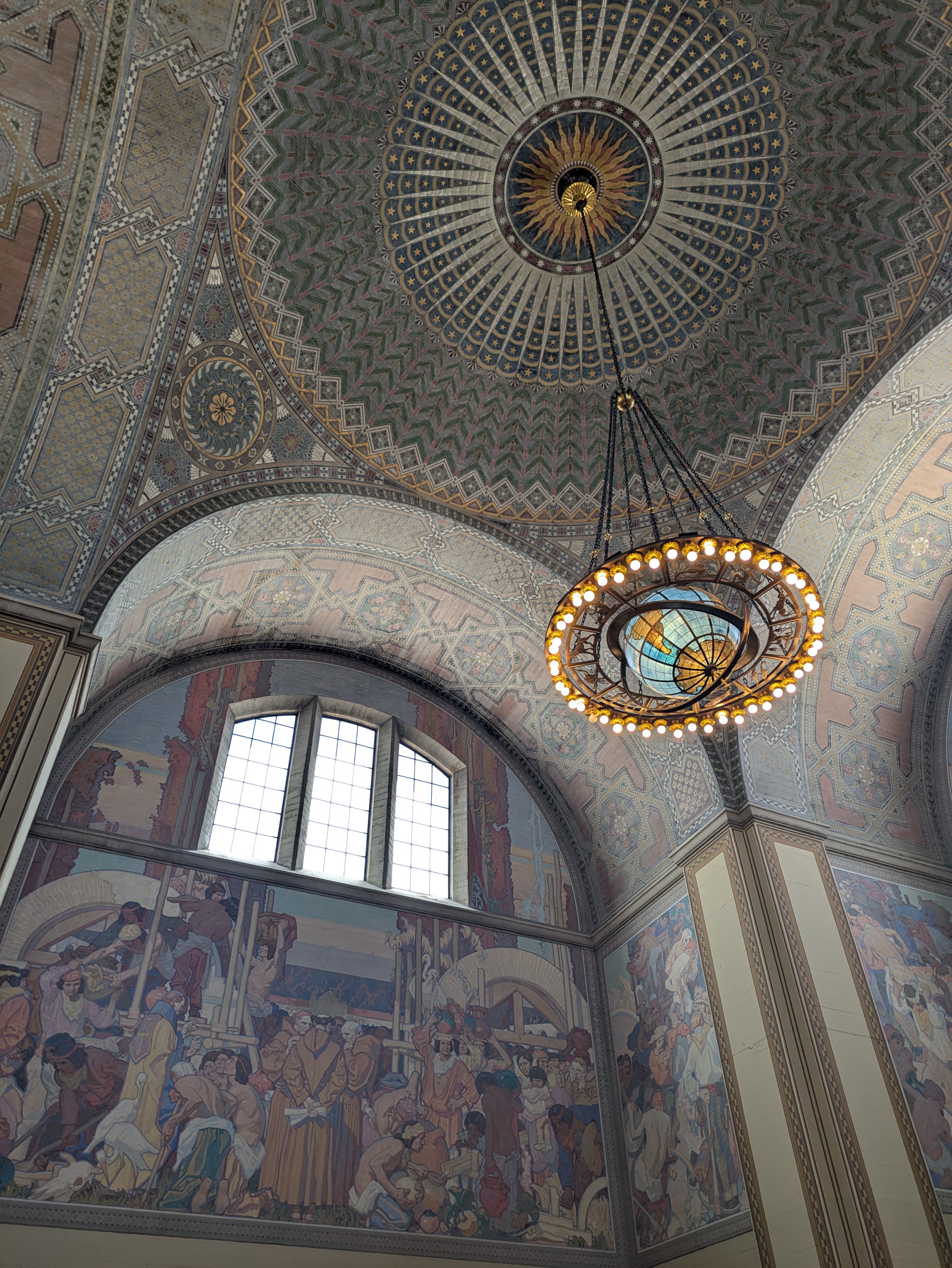
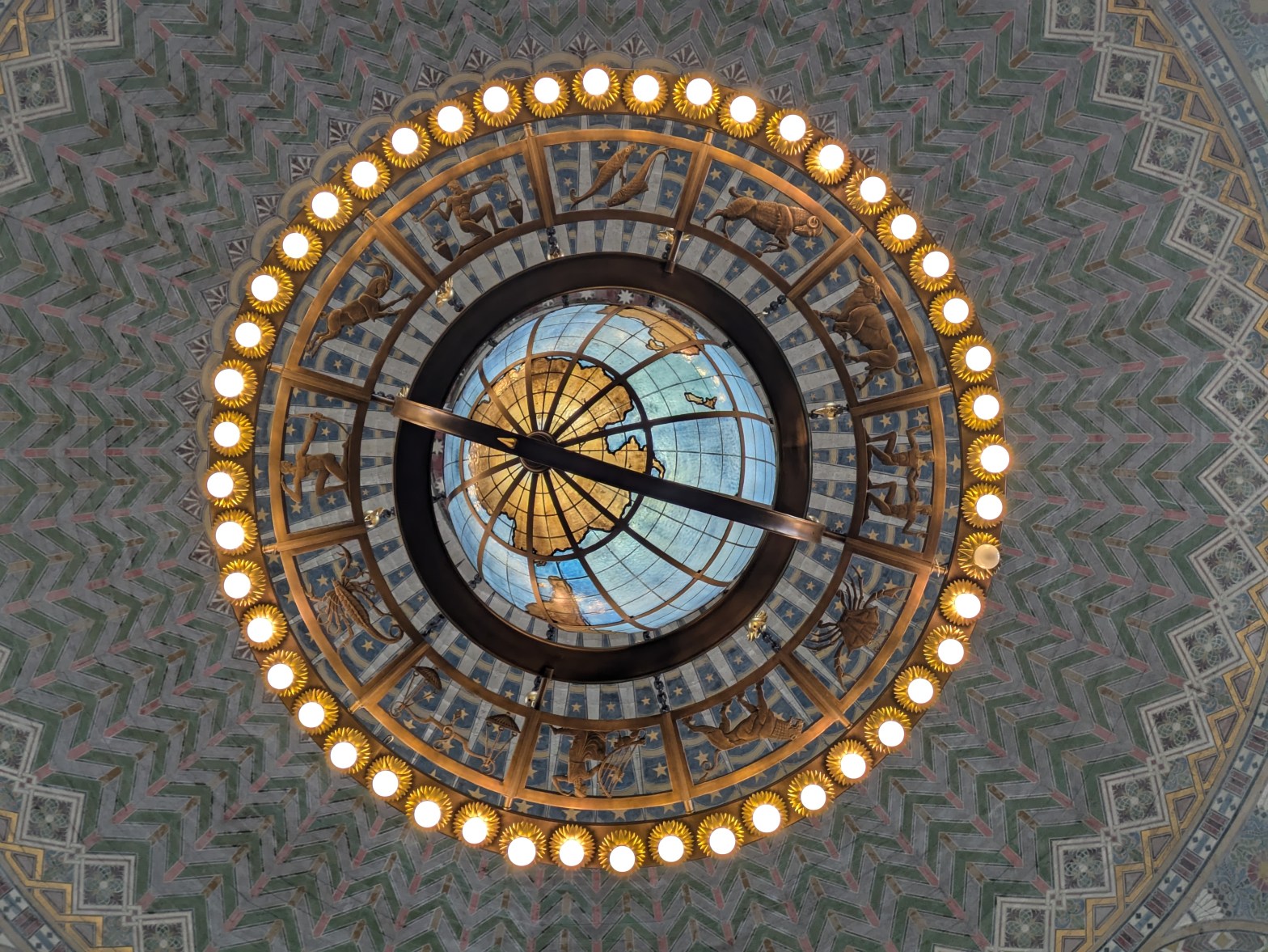
Following the theme of light and learning, the centerpiece of the rotunda is a monumental chandelier, sporting an illuminated globe of the Earth surrounded by a ring of forty-eight lightbulbs and bronze representations of the zodiac signs. Coupled with the sun and stars inlaid into the top of the ceiling nearly a hundred feet above you, the whole thing is meant to represent the solar system.
The other main feature of the rotunda are the murals, painted by noted illustrator Dean Cornwell, who deliberately chose a muted color palette to harmonize with the ceiling. The murals depict a romantic interpretation of California history, beginning with the arrival of the Spanish and illustrating the development of the missions and the later Americanization of Southern California.
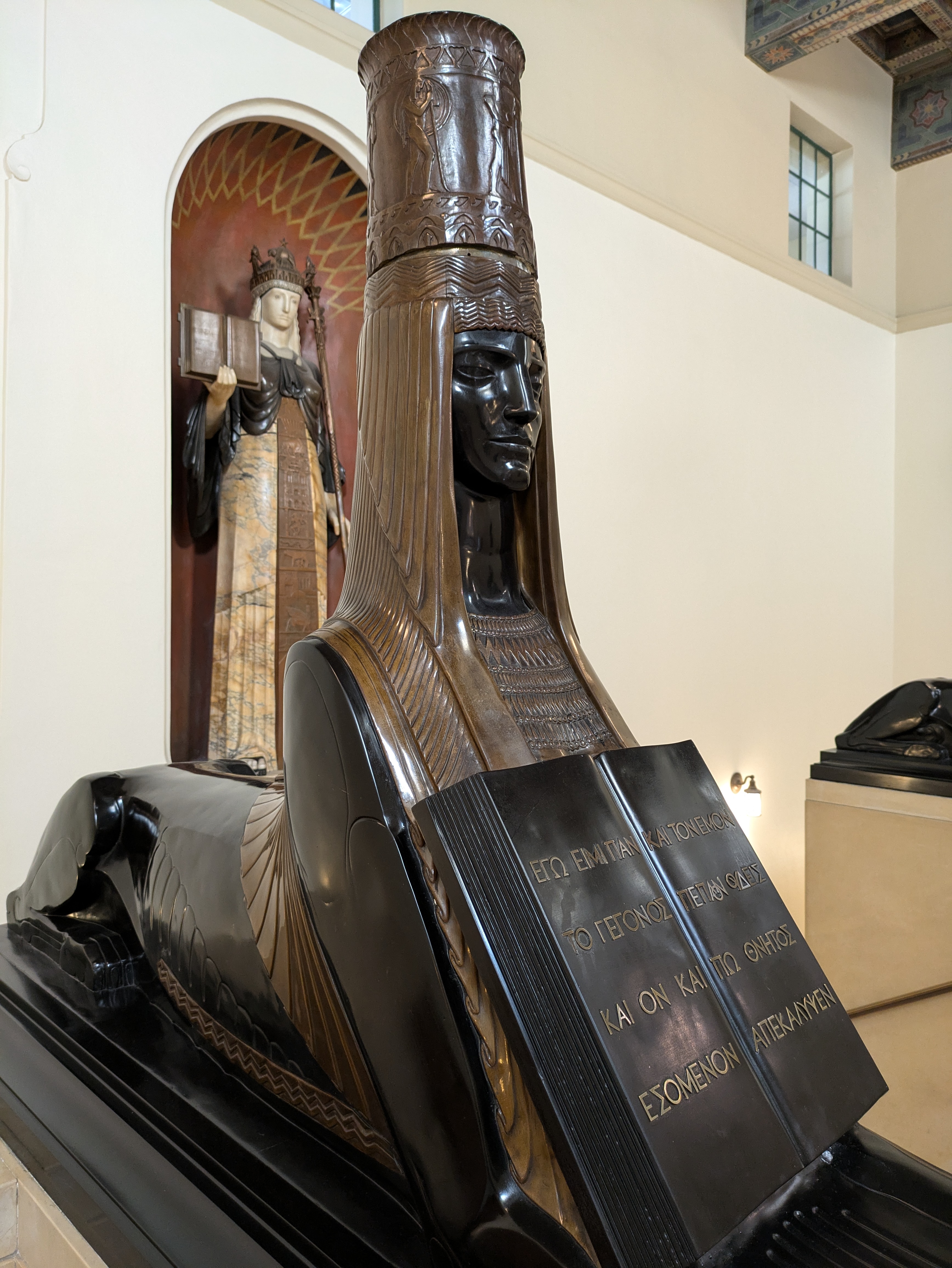
Another highlight of this floor is the sculptures positioned at the end of the north and west hallways off of the rotunda. The stairwell on the north side is adorned with two sphinxes sculpted from black marble guarding the marble and bronze Statue of Civilization in the niche in the wall, whose crown sports a miniature of the library itself, as well as a bear to represent California and angels representing Los Angeles. In a niche at the end of the other hallway, you can find a massive sculpture of a hand grasping a torch, which is the original version of a decoration that sits atop the pyramid on the roof.

The second floor is also home to the Getty Gallery, which sits just around the corner from the rotunda. This gallery hosts changing exhibits focused on L.A. arts and culture, and tend to be very well curated.
Atrium
It didn’t take long for the original library building to start bending under the weight of the demands placed on it. By the 1960s, the structure was outdated, breaking down, and completely out of room even as Los Angeles grew exponentially. There was talk of demolition, of replacement, and a ’70s expansion proposal which went nowhere. Finally, a new expansion effort in the ’80s starting building momentum just as a devastating fire erupted in the Central Library on April 29, 1986, fueled by the overcrowded closed stacks and consuming 375,000 books and damaging 750,000 more. The event inspired an outburst of civic energy, with a massive book-salvaging campaign and renewed enthusiasm for the expansion effort.
The newly renovated and expanded library opened in 1993, with a massive eight-story wing added on the east side of the building. Half of it is underground, to avoid overshadowing the original structure, with most of the stacks moved over to the new wing while the administration and circulation functions remain in the original building.
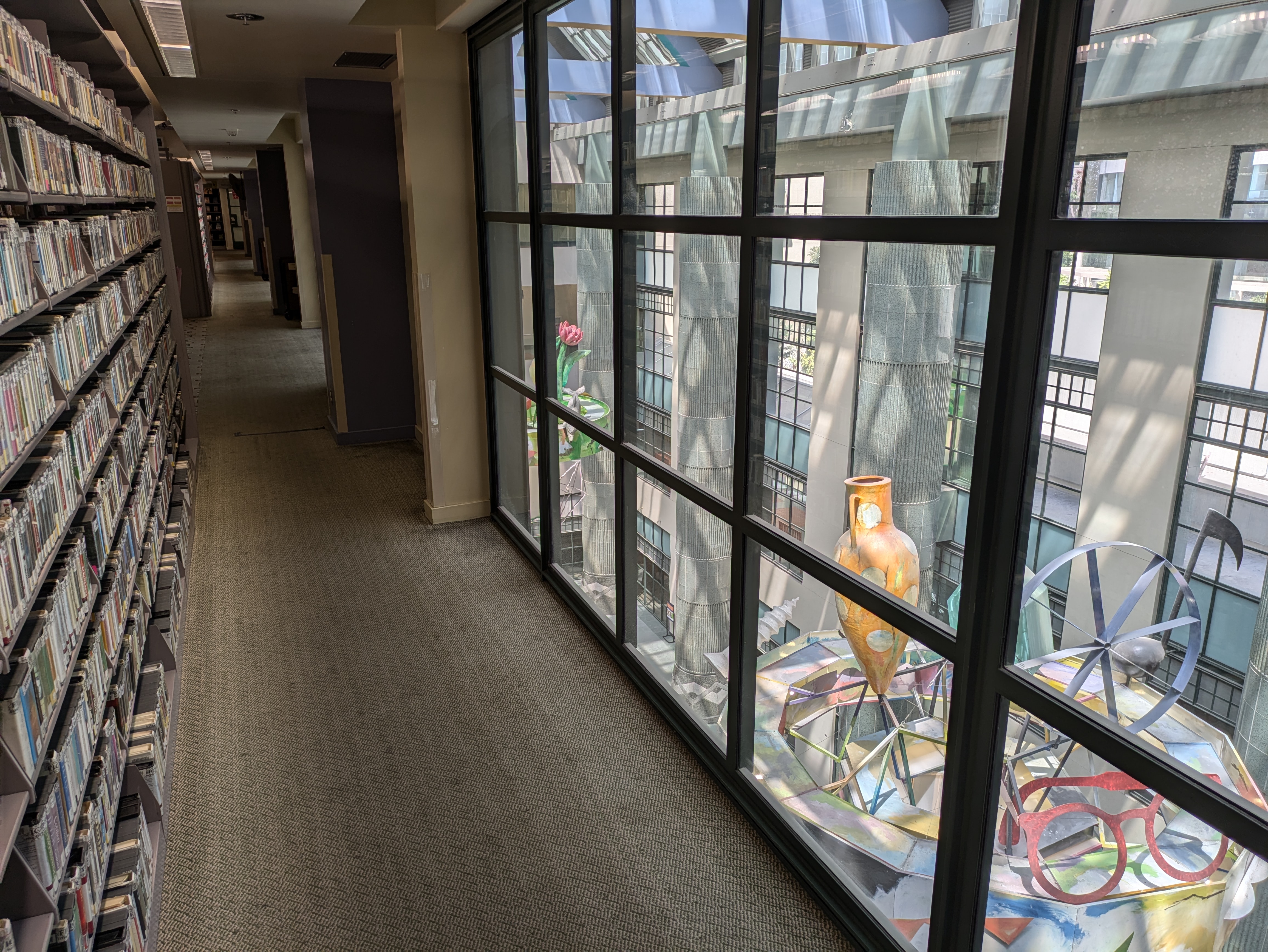
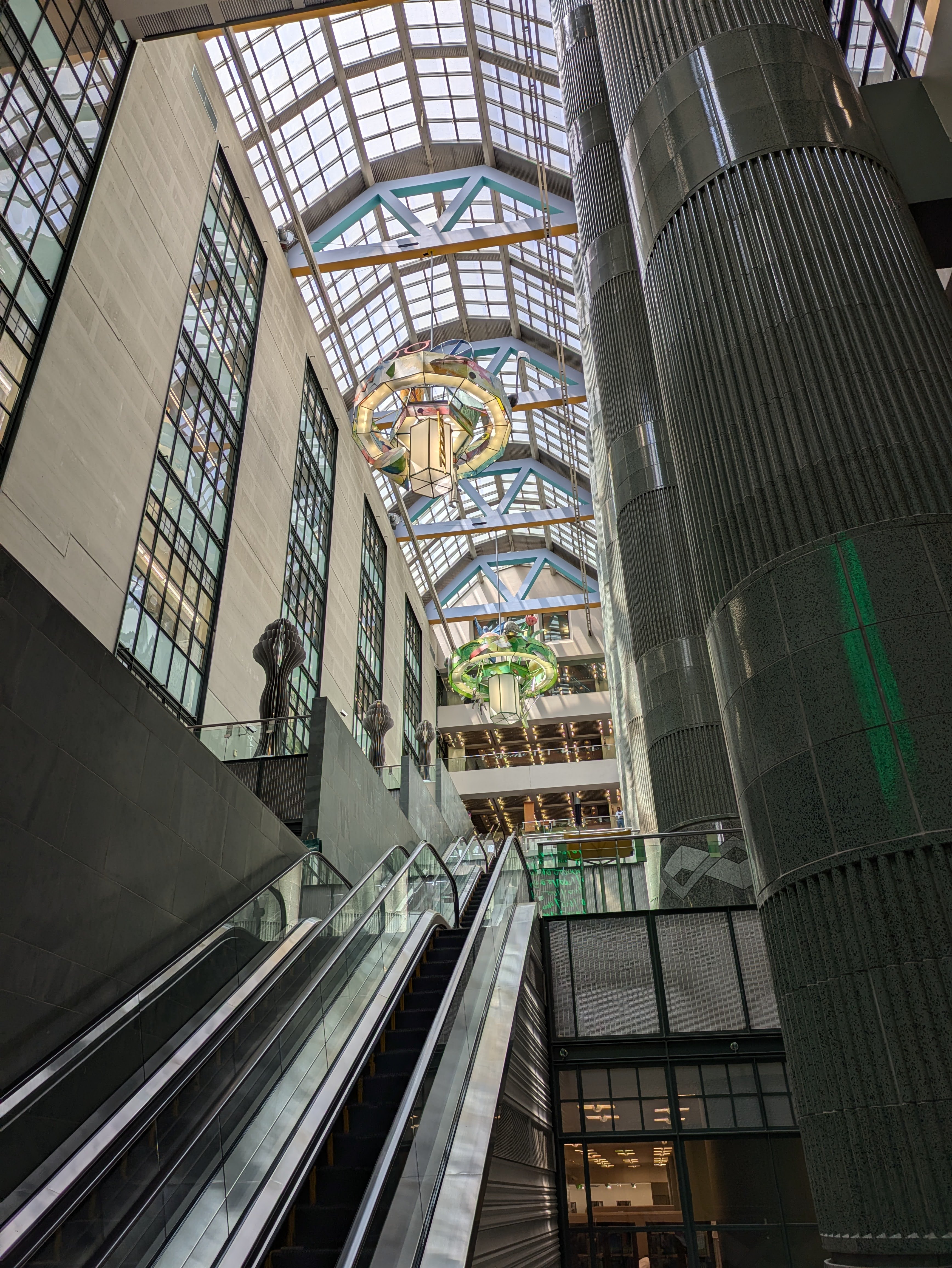
The highlight of the new wing is the towering sunlit Atrium, which is just as architecturally impressive as the Rotunda. Below you, a series of escalators cascade down to the bottom floor, while above hang three massive colorful chandeliers designed by Therman Statom, covered in playful-looking objects. The best views of the chandeliers are from the 3rd Floor, where you can look down on them through the windows of the Literature/Fiction section. (And while you’re here, see if you can find the Short Story Dispenser, a machine that will print out a short story for you when requested.)
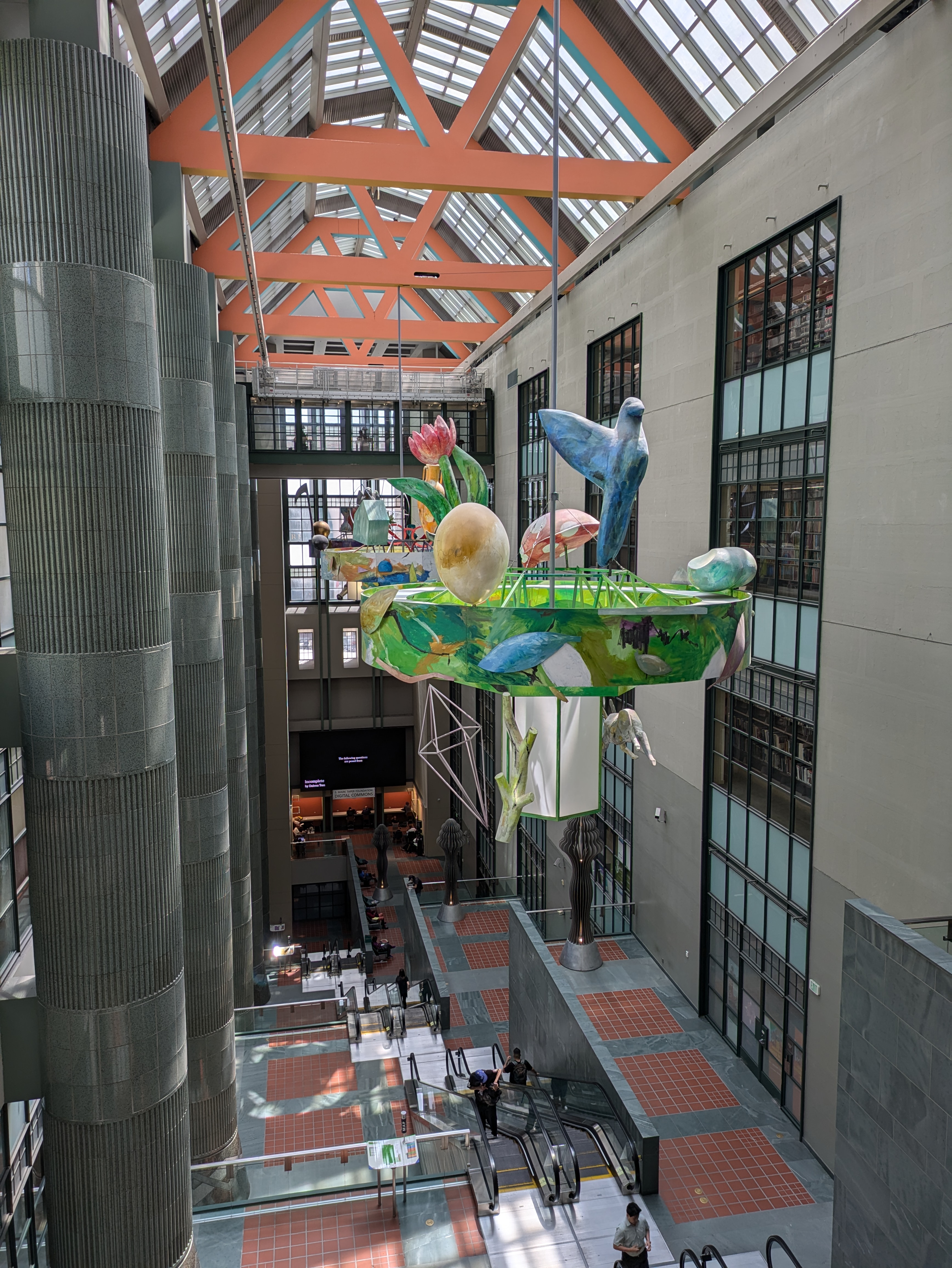
Descending the escalators to the bottom of the Atrium, you can admire the sheer scale of the space, with massive green terra cotta pillars and curvilinear lanterns designed by Ann Preston that fit the subdued tones of the room.
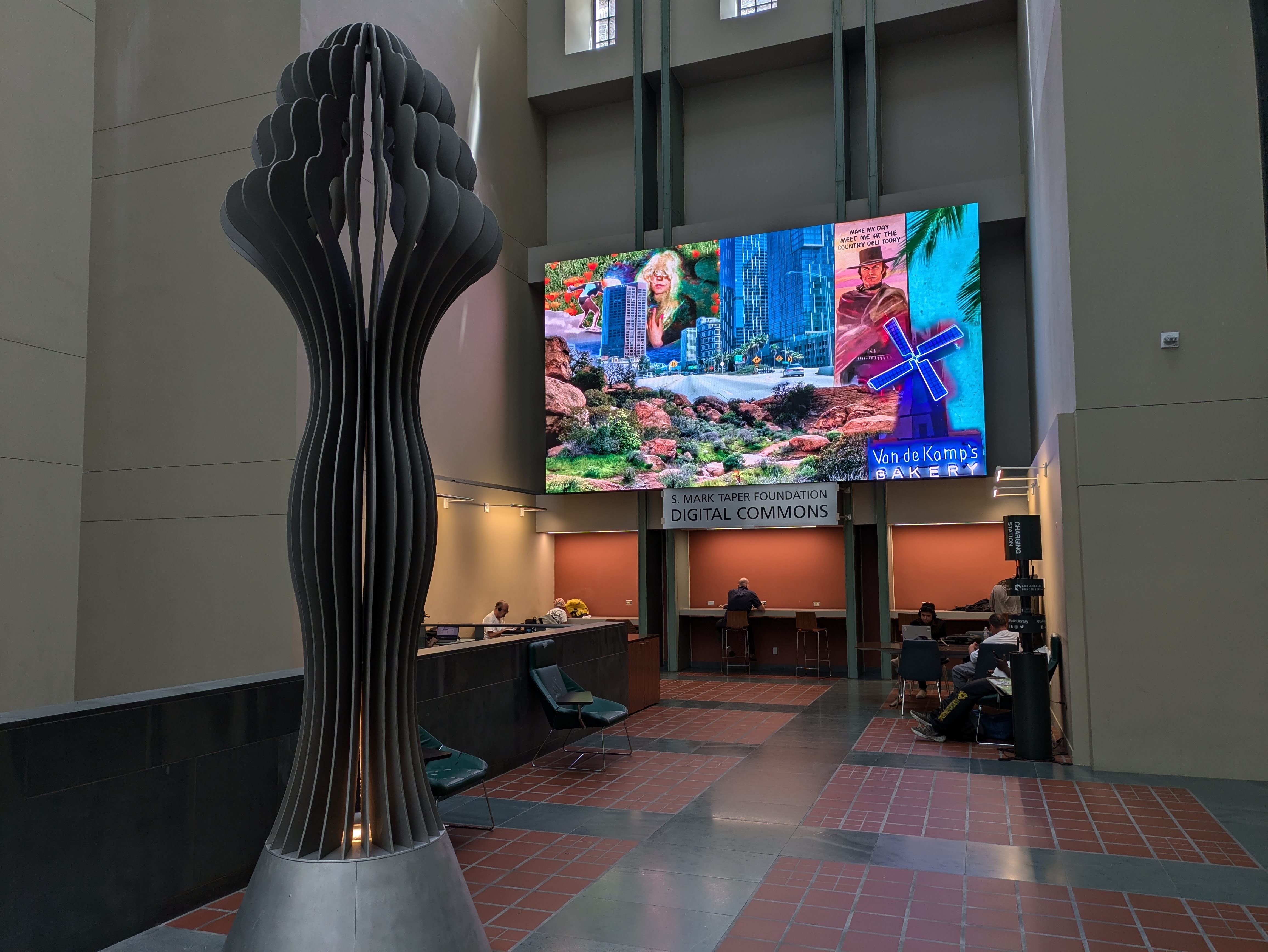
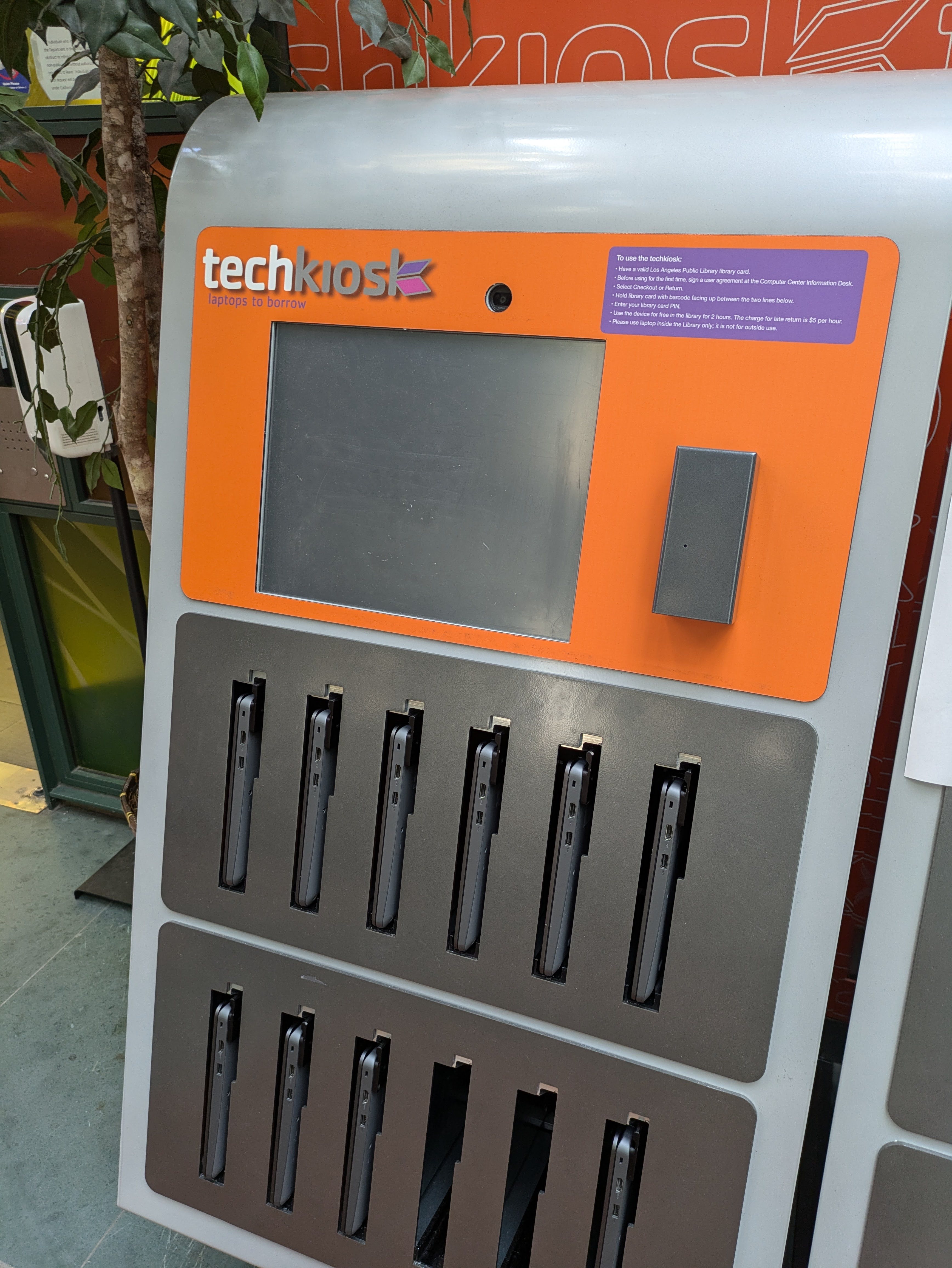
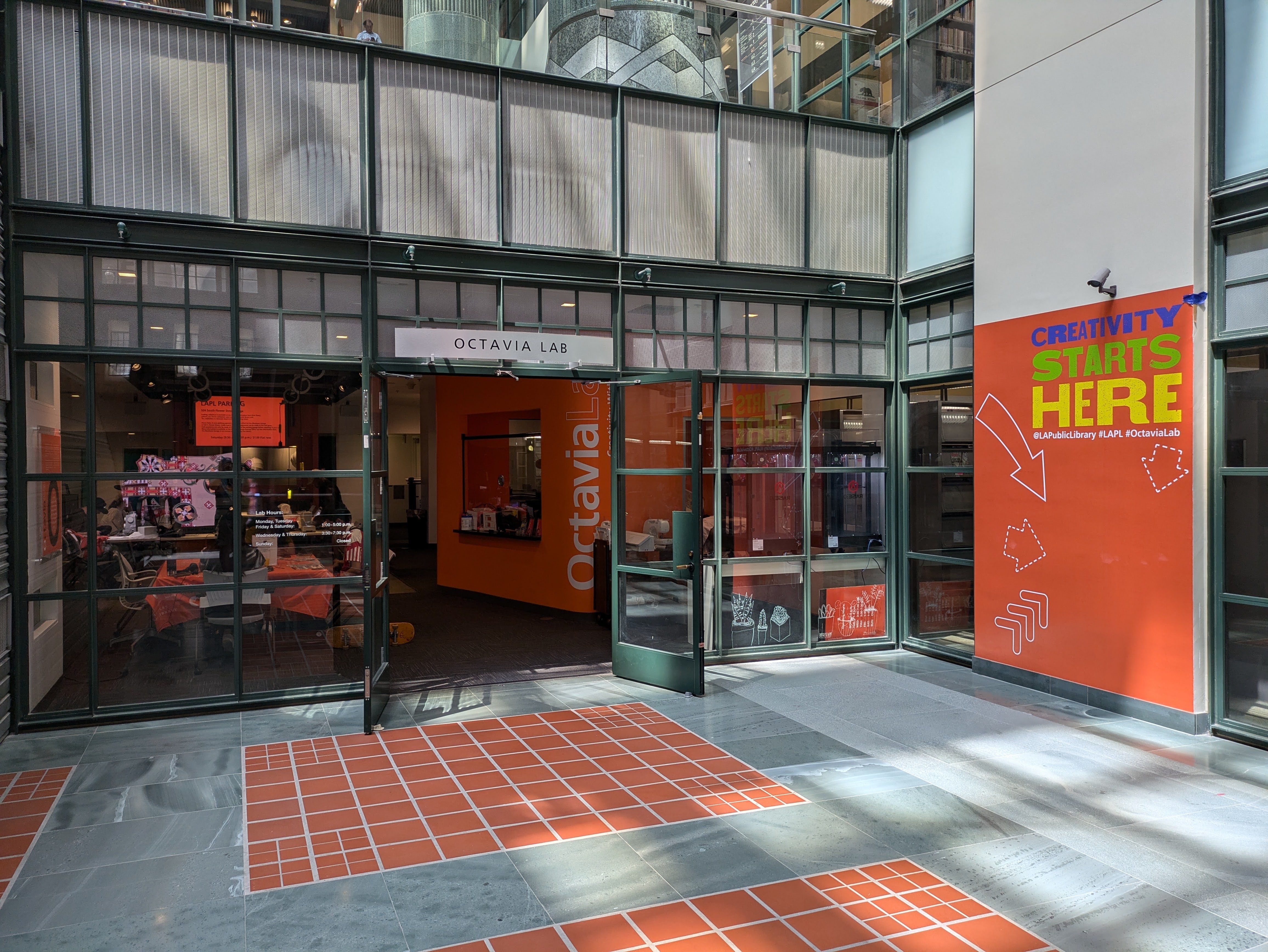
One of the oft-highlighted gems of Central Library is the Octavia Lab, a maker space on Lower Level 2 that provides tech resources for creators, including recording studios, 3D printers, computer stations, photography studios, large-scale printers, and even sewing machines.
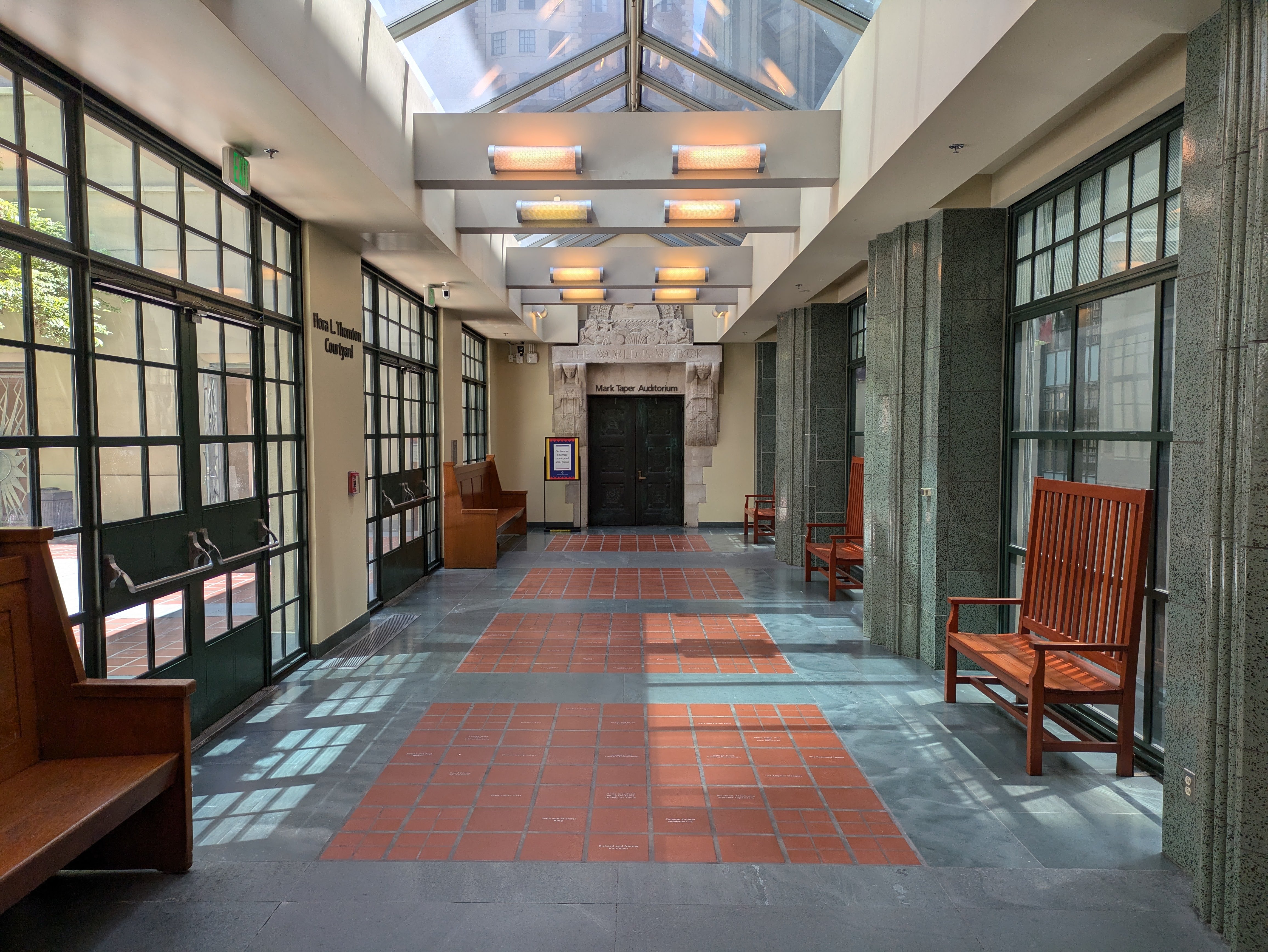
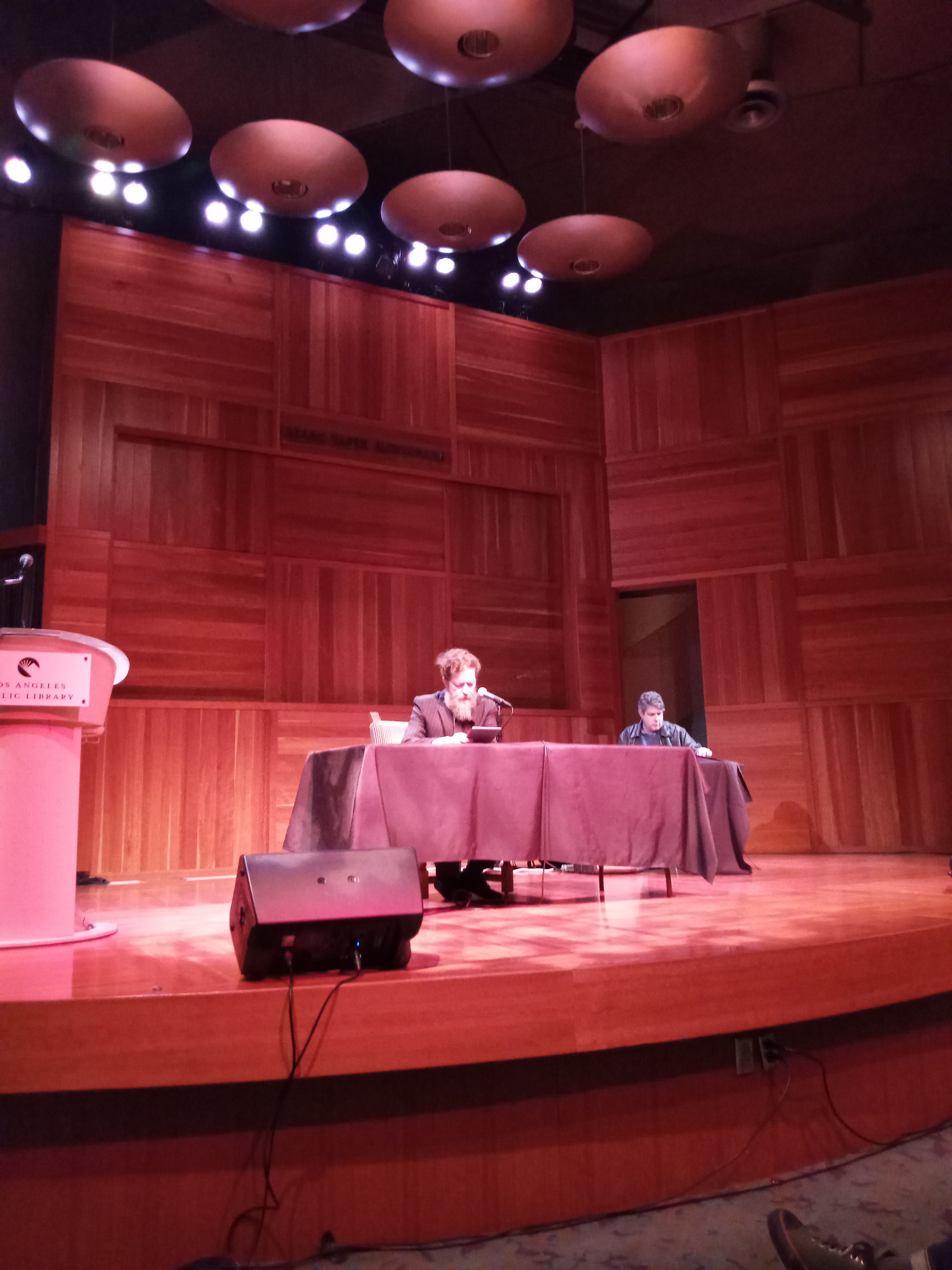
Another feature of the wing is the Mark Taper Auditorium, tucked into a corner of the 1st Floor, which hosts lectures, shows, and various events. The auditorium itself isn’t much to speak of, but the entrance to the auditorium is adorned with the sculpture that was originally above the eastern entrance to the original building, which was demolished to make way for the new wing.
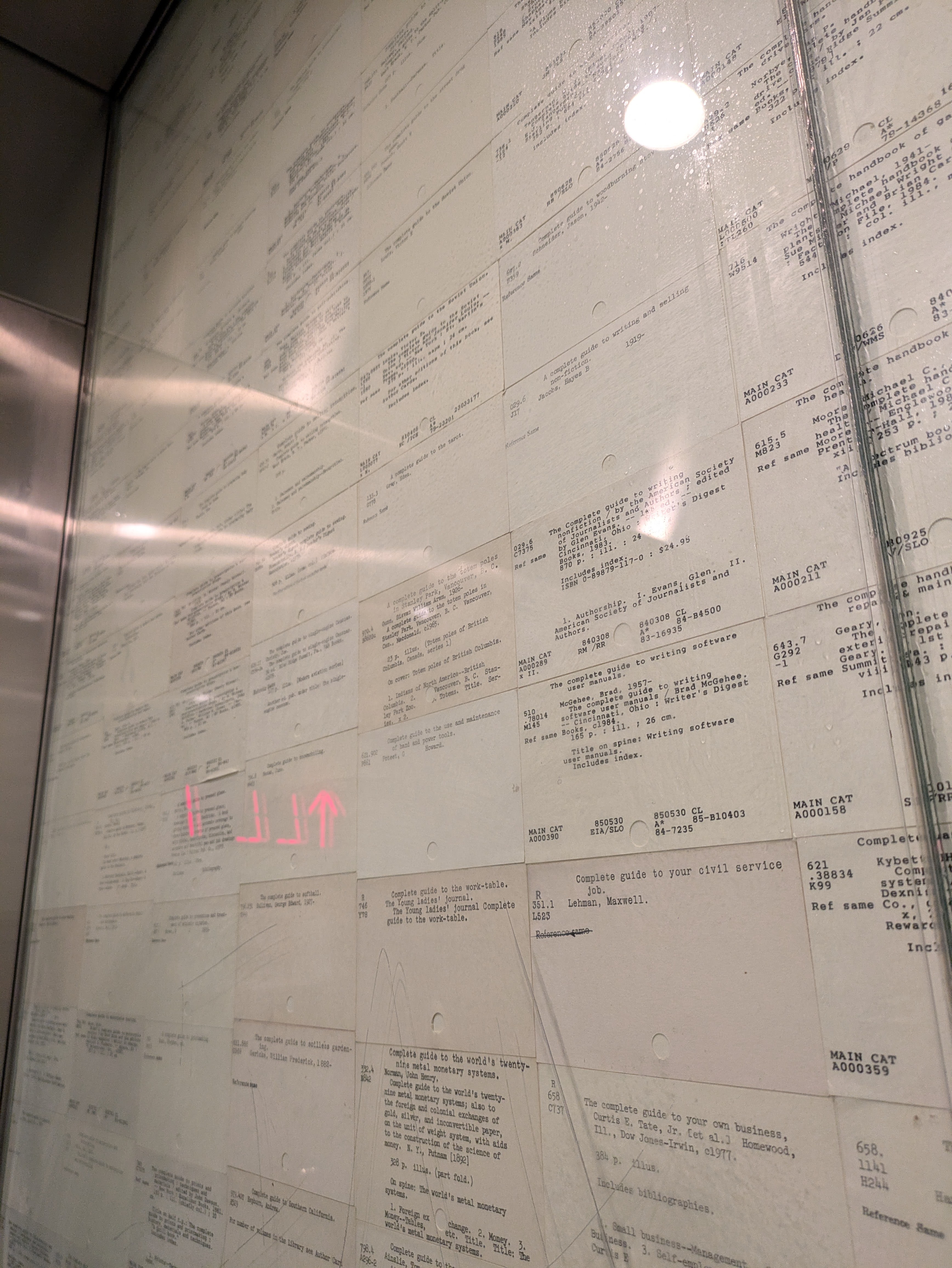
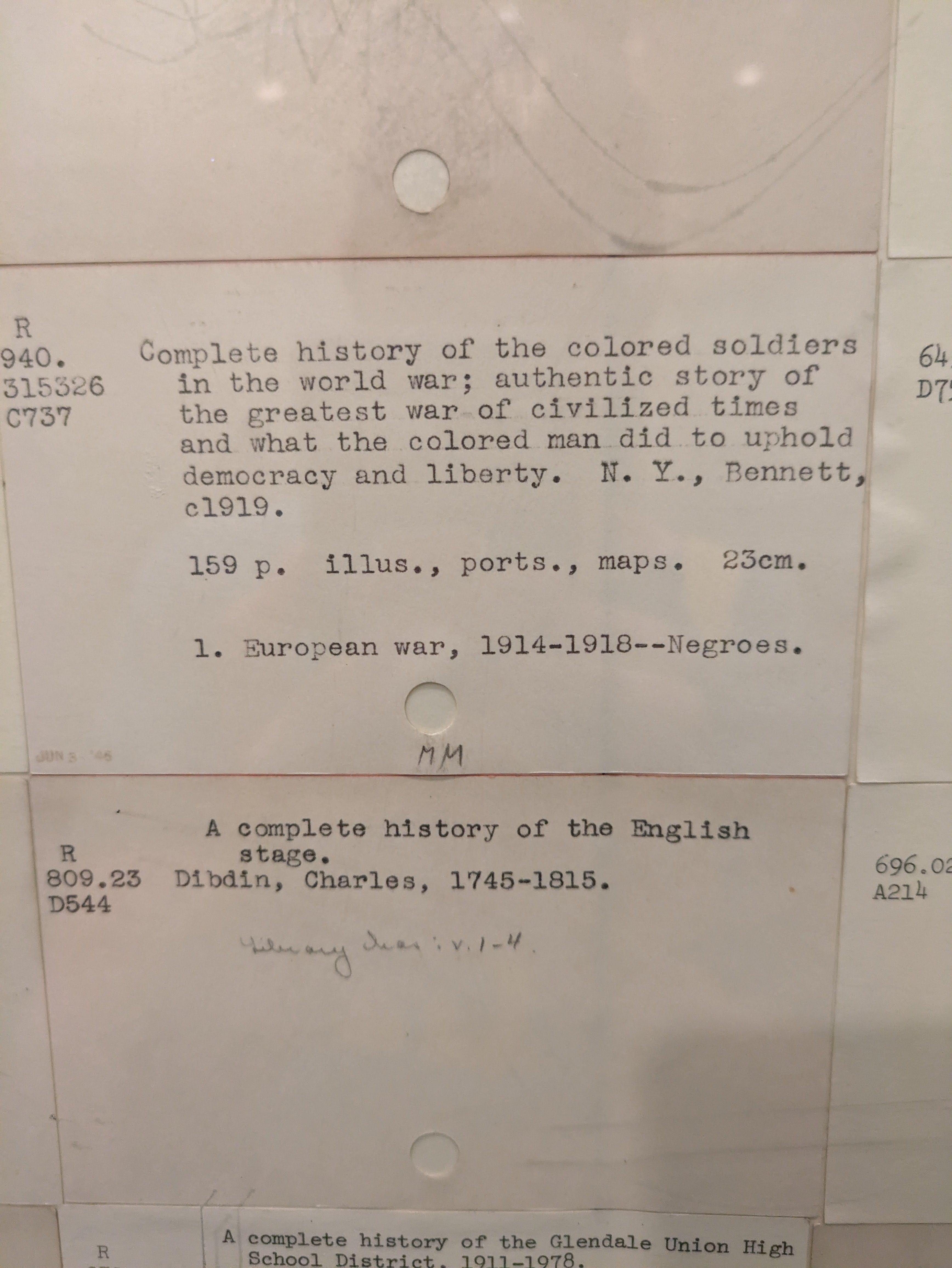
A great and (somewhat) hidden feature of the wing is in the elevators. During the renovation, artist David Bunn got his hands on the old index card catalog for Central Library. With it, he created A Place for Everything and Everything in its Place, with index cards lining the walls of each elevator cab, as well as the elevator shafts. As you ride the elevator, you can look over the titles of some of the many books belonging to the library, which also reference the sections served by the elevators.
We can only cover so much in this guide, but if you want a very detailed look at the library’s history and architecture, we highly recommend the book Los Angeles Central Library: A History of its Art and Architecture by Arnold Schwartzman and Stephen Gee, which served as an excellent resource for this guide. The library is also ever-changing, hosting new events and new exhibitions and spotlighting new facets of the city’s culture, so we would also recommend following LAPL’s Instagram page, which is very well curated and does a great job showcasing the library’s many different departments and offerings.
 Transiting Los Angeles
One thought on “The Central Library”